Animal Nutrition Market Overview:
As per the Food and Agriculture Organization of the United Nations, the global population will reach the 9 billion mark by 2050, constructing food challenges. Owing to the depletion of arable land as a result of industrialization, food security is a major objective and livestock products are among the prime means to meet such objectives. Economic development has induced pressure on the livestock sector for more efficient production with limited resources; it also supports the income and food security of almost 1.3 billion people. Thus, animal farming sector is capitalizing upon food security concerns, accounting for nearly 40% of the global agricultural production value. Animal nutrition is a necessity with increasing uptake, for the mandatory affluence of global livestock sector and primarily for the rampant production of protein-enriched commodities such as meat, eggs, and milk to feed the majority of the non-vegetarian population globally. Apart from animal husbandry, animal nutrition market has found a tremendous scope of application in households, veterinarians, zoos, and animal shelters. As of 2018, global animal nutrition market size was around $16.80 billion to $17.01 billion and the arcade is estimated to be progressing at a global compound annual growth rate (CAGR) of 5%-6% during the forecast period 2019-2025.
Animal Nutrition Market Outlook:
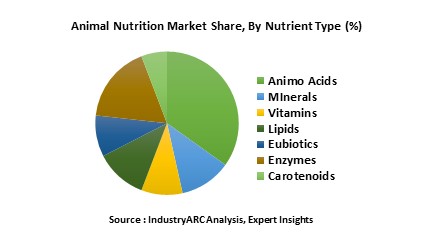
Animal nutrients are dietary needs of animals such as macronutrients, vitamins, dietary mineral, enzymes, eubiotics, and amino acids, and are very essential in efficient meat and milk production, reproduction, and proper bone structures. As per the nutrients segmentation, amino acids hold the apex spot and is progressing with an application CAGR of 5.5% - 6.5% going through 2025. Amino acids are requisite for several biological operations such as protein synthesis, carriage, and the storage of other nutrients. Also, quality animal-based food products such as meat, milk, and eggs are obtained by optimal supplementation of amino acid. As per the International Dairy Federation, consumption of dairy products is expected to increase by 25% between 2015 and 2024, therefore dairy operations to match their production with unprecedented demand is augmenting the application of amino acids and subsequently disrupting the animal nutrition market growth.
After an acute analysis of the regional aspects, APAC is reckoned to be the dominating region with nearly 29% - 31% of animal nutrition market global demand settling under its territory. Such dominance can be attributed to several factors such as increasing meat consumption in densely populated economies of India and China with nearly 35% of the global population. Improving health awareness among individuals creating demand for livestock-based proteins such as milk, egg, and meat.
Request Sample @ https://www.industryarc.com/pdfdownload.php?id=15015
Several supporting facts by Department of Animal Husbandry and Dairy (INDIA):
23 % of agricultural households reported livestock as their principal source of income.
As per 19th Livestock census, there are 88 million In-Milk animals.
India holds the 1st rank among the global milk producing nations since 1998 with the largest bovine population globally.
- 176.4 million tonnes of milk production was recorded in 2017-2018, an increment of 6.65% from the preceding year.
Animal Nutrition Market Growth Factor and Trends:
- MEAT to MEET GLOBAL FOOD DEMAND-
Animal Nutrition Market Challenges:
Animal Nutrition Market Players Perspective:
Animal Nutrition Market Research Scope:
Animal Nutrition Market Report: Industry Coverage
- North America: The U.S., Canada, Mexico
- South America: Brazil, Venezuela, Argentina, Ecuador, Peru, Colombia, Costa Rica
- Europe: The U.K., Germany, Italy, France, The Netherlands, Belgium, Spain, Denmark
- APAC: China, Japan, Australia, South Korea, India, Taiwan, Malaysia, Hong Kong
- Middle East and Africa: Israel, South Africa, Saudi Arabia
Key Questions Addressed in the Animal Nutrition Market Report
A few focus points of this Research are given below
- Give a deep-dive analysis of the key operational strategies with a focus on the corporate structure, R&D strategies, localization strategies, production capabilities, and sales performance of various companies
- Provide an overview of the product portfolio, including product planning, development, and positioning
- Discuss the role of technology companies in partnerships
- Explore the regional sales activities
- Analyze the market size and giving the forecast for the current and future Animal Nutrition Market during the forecast 2019–2025
- Analyze the competitive factors, competitors’ market shares, product capabilities, and supply chain structures.
Comments
Post a Comment